
Wooden or Biodegradable Plastic Cutlery for Delivery?
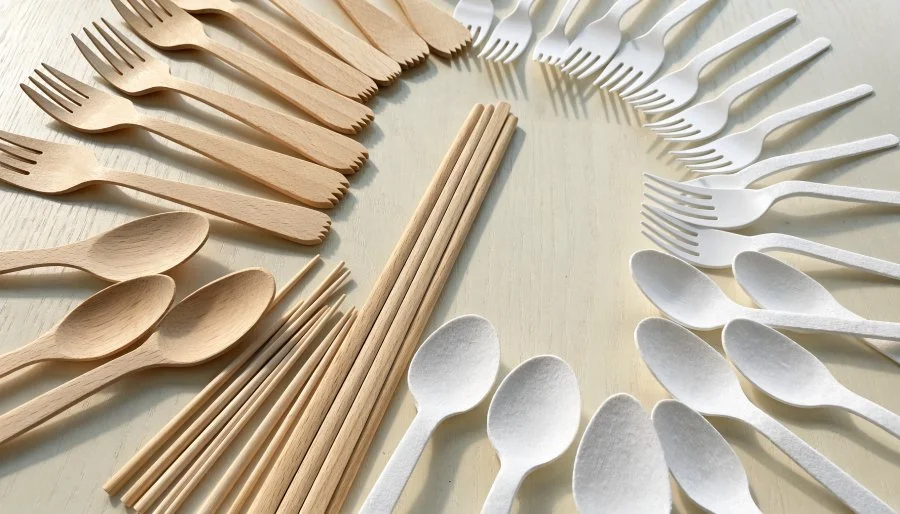
The cutlery question used to be simple. You dropped a fork and spoon into every bag and nobody thought twice about it. Then delivery platforms started asking customers to opt in, sustainability came up at every supplier meeting, and a five-cent item quietly turned into a decision.
Wooden or biodegradable plastic is the fork in the road most F&B businesses reach first. Both are a step away from conventional plastic, both cost a little more, and they suit different food in ways that are easy to get wrong.
What each one is
Wooden cutlery is what it sounds like, usually birch or a similar light hardwood, cut and pressed into forks, spoons, knives, stirrers and chopsticks. It is a natural material and it biodegrades, meaning microbes break it down over time.
Biodegradable cutlery made from plastic is a different animal. It keeps the shape, flex and smooth finish people are used to, while being formulated to break down faster than conventional plastic once discarded. Neither of these is the same as compostable, which describes a material that breaks down into non-toxic components within a defined timeframe under specific composting conditions, usually industrial ones.
How they feel in a customer's hand
This is where the two genuinely part ways. Wooden cutlery has texture. A lot of customers like it and read it as a signal that the business is trying, while a smaller group finds the dry mouthfeel of a wooden spoon unpleasant, especially with soup or ice cream.
Biodegradable plastic behaves the way people expect cutlery to behave. It is smooth, it does not absorb flavours, and nobody notices it at all, which for plenty of food is precisely the point.
There is no universally correct answer here, only a fit with your food and your crowd. A brunch cafe with a natural, earthy brand often finds wooden cutlery reinforces what customers already believe about it. A zi char stall sending gravy-heavy plates out on delivery usually hears fewer complaints with plastic.
Where each one holds up
Strength tends to be the practical tiebreaker. Wooden forks handle salads, rice and cake without drama, but they can struggle against dense or fibrous food, and a wooden knife against a firm piece of chicken is optimistic at best. Biodegradable plastic flexes before it fails, which gives a customer a fighting chance with tougher items and fewer snapped handles at the bottom of the bag.
Storage and shelf life in a small kitchen
Something operators only discover after their first bulk order is that wooden cutlery is sensitive to humidity, which Singapore has in abundance. Left in an open box near a wash area or a steamer, wooden pieces can warp slightly or pick up a musty smell, so they want a dry shelf and a sealed carton once opened.
Biodegradable plastic is less fussy day to day, though the same rule applies to both: keep stock away from direct heat and rotate it properly instead of letting a carton sit at the back for a year.
The cost conversation
Both options typically cost more per piece than conventional plastic cutlery, and how much more depends on your order volume, the exact item and whether you want anything customised. Those differences are indicative and move with the market, so the number to watch is your monthly spend across real order volumes, not the price of a single fork.
One useful lever costs nothing at all. Since delivery platforms began asking customers whether they want cutlery, many businesses have found their usage drops sharply without a single complaint, and NEA's Say YES to Waste Less campaign has been nudging the F&B scene in the same direction for years. Sending fewer sets out softens the cost of upgrading the ones you do send.
Look at the whole line item across a month before deciding anything. A cent or two per piece feels like nothing on a single order and reads quite differently across a thousand of them.
A simple way to choose
Run your menu against a few practical questions before placing an order.
Is the food hot, wet or heavy on gravy?
Will the customer need to cut anything?
Does dessert or ice cream travel on the same order?
Does your brand lean natural and handmade, or clean and modern?
Are you sending cutlery with every order, or only on request?
Do you need stirrers or chopsticks in the mix as well?
Plenty of businesses land on both. Wooden cutlery for drinks, desserts and dry mains, plastic for the messy dishes. Splitting the order costs a little more in stock lines and saves a lot in complaints.
If you go that way, keep the two clearly separated at the packing station. Staff working through a lunch rush will grab whatever is nearest, and a wooden knife heading out with a steak set is exactly the mix-up you were trying to avoid.
Beyond the takeaway bag
Cutlery has a habit of finding a second life once it leaves your kitchen, from craft projects to office pantries, and we have written before about biodegradable tableware beyond dining. For a food business, the more immediate benefit is a small, visible signal to customers that some thought went into what ends up in the bag.
Be careful about how far you take that signal, though. Biodegradable cutlery still needs to be disposed of, and how quickly it breaks down depends on where it ends up. Describing it as compostable, or promising a specific outcome, invites exactly the scrutiny you were hoping to avoid. Saying that you have moved to a biodegradable range and explaining why is accurate, modest and much easier to defend.
The same goes for the switch itself. Changing your cutlery will not offset much on its own, and customers can tell when a small change gets dressed up as a large one.
Try before you decide
Neither option is a silver bullet, and neither will transform your footprint on its own. What they give you is a defensible answer when a customer asks, and a bag that feels considered.
If you would like to handle a few options before deciding, SKP stocks both wooden and biodegradable plastic ranges across the usual sizes. Come down or drop our team a message, and we will talk through what suits your dishes.